 EN
EN


As environmental awareness reshapes purchasing decisions and regulatory landscapes, packaging manufacturers and brand owners are under increasing pressure to justify every material choice they make. In-mold labels have emerged as a widely adopted solution in plastic packaging, celebrated for their durability, visual quality, and streamlined production process. But when the conversation turns to sustainability, the picture becomes more nuanced. Are in-mold labels genuinely eco-friendly, or is the green narrative surrounding them more marketing than substance?
The sustainability credentials of in-mold labels are not black and white. They depend heavily on the substrate materials involved, the end-of-life pathways available in a given market, and how their environmental footprint compares to the labeling alternatives they replace. This article examines those dimensions carefully, offering a grounded, evidence-based perspective on whether in-mold labels deserve their eco-friendly reputation and under what conditions that reputation is truly warranted.
Understanding What In-Mold Labels Are and How They Work
The Integrated Labeling Concept
In-mold labels are pre-printed label inserts that are placed directly into the mold cavity before or during the plastic injection, blow molding, or thermoforming process. As the molten plastic flows into the mold and cools, it fuses with the label, creating a single unified structure. The label does not sit on top of the container — it becomes part of it. This integration is the defining characteristic that separates in-mold labels from pressure-sensitive or sleeve labels applied after production.
Because the label is chemically bonded to the container during manufacturing, the resulting product is physically homogenous. This has important implications both for performance and for downstream recycling behavior. A container with in-mold labels has no adhesive layer to delaminate, no paper-fiber contamination to introduce during reprocessing, and no secondary material to sort out during waste management. These structural attributes form the foundation of the sustainability argument in favor of in-mold labels.
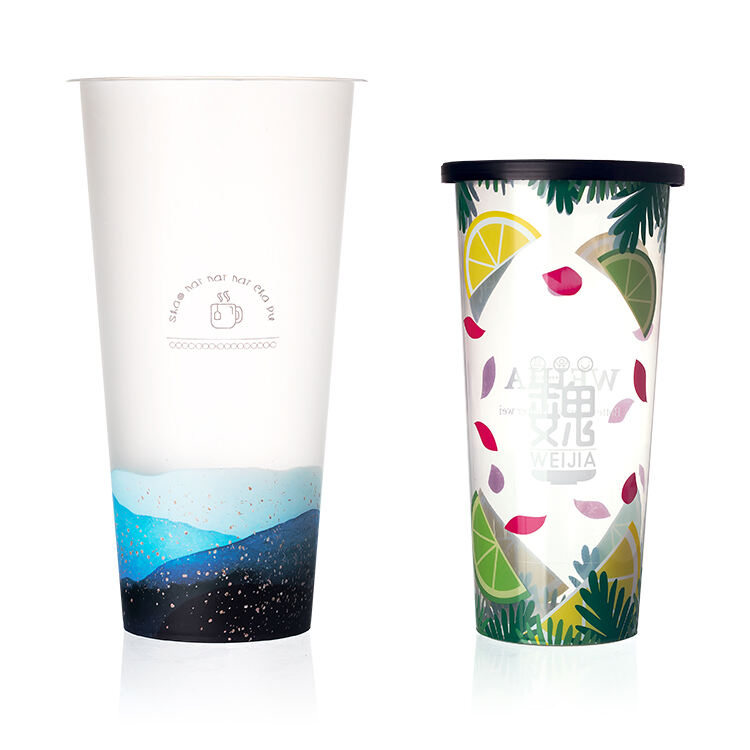
The technology is especially prevalent in food-grade packaging such as dairy containers, portion cups, and beverage packaging. For instance, injection-molded polypropylene cups designed for milk tea and similar beverages frequently utilize in-mold labels because the labeling must survive condensation, handling, and temperature variation without peeling or degrading.
Materials Commonly Used in In-Mold Labels
The sustainability profile of in-mold labels is closely tied to the materials from which they are made. Most in-mold labels are produced from polypropylene (PP) film, which matches the substrate of the container it is applied to. This material compatibility is central to the recycling argument: when both the label and the container are made from the same polymer family, the entire assembly can theoretically be processed in a single recycling stream without separation.
Some in-mold labels use polyethylene (PE) films or co-extruded multi-layer films depending on the forming process and barrier requirements. The choice of film affects ink adhesion, heat resistance, and ultimately recyclability. Inks used on in-mold labels are typically UV-cured or water-based formulations, and the shift toward ink systems that do not contaminate recycling streams is an active area of development within the industry.
Understanding these material variables is essential for any brand owner or packaging engineer evaluating in-mold labels as a sustainability strategy. The label is not a single standardized product — it is a family of solutions with widely varying environmental profiles depending on material selection and manufacturing context.
The Recyclability Argument: Strengths and Real-World Limitations
Why Same-Polymer Integration Matters for Recycling
The most compelling sustainability argument for in-mold labels is their potential compatibility with mono-material recycling. When a PP container carries a PP in-mold label, the entire package is theoretically classified as a single material. Recyclers do not need to remove the label before shredding and reprocessing because the label and container will melt and reform together. This is a meaningful advantage over paper-labeled plastic containers, where fiber contamination can downgrade the quality of the recovered resin.
From a circular economy standpoint, in-mold labels support design-for-recyclability principles by eliminating the need for label separation at the consumer or industrial level. This reduces sorting complexity and makes it more likely that the container actually enters and completes the recycling cycle rather than being rejected as a mixed-material waste stream. The European packaging industry has increasingly recognized this advantage, with several life cycle assessments showing that in-mold labels reduce the number of material streams required during post-consumer processing.
However, the benefit only materializes when effective collection and sorting infrastructure exists. In markets where plastic recycling rates are low or where PP specifically is not collected separately, the mono-material compatibility of in-mold labels offers no practical advantage. The label's theoretical recyclability means little if the container ends up in landfill or incineration regardless of how it is labeled.
Challenges That Complicate the Recyclability Picture
Several real-world challenges temper the recyclability claims surrounding in-mold labels. First, ink layers — even when compatible in terms of polymer chemistry — can affect the optical sorting of packaging at materials recovery facilities. Near-infrared (NIR) sorting technology, which is the primary method used to identify polymer types in modern recycling plants, can be confused by heavily printed surfaces. Dark or metallic ink coverage on in-mold labels has been documented as a factor that causes misidentification during automated sorting, resulting in otherwise recyclable containers being diverted to residual waste.
Second, not all in-mold labels are made from the same polymer as the container. A PE label on a PP container introduces a dissimilar material that can reduce the purity and quality of the recovered resin. Even if the volume of label material is small relative to the container, the presence of a different polymer can be problematic for processors seeking to produce food-contact-grade recycled PP.
Third, the adhesion between the label and the container achieved during molding can be extremely strong — so strong that any attempt to mechanically separate the two in a recycling scenario becomes impractical. This is generally not a problem when the materials are compatible, but it becomes a significant issue when label and container materials diverge. For these reasons, environmental claims about in-mold labels should always specify the material system involved rather than treating all in-mold label applications as uniformly sustainable.
Comparing the Environmental Footprint: In-Mold Labels vs. Alternatives
Pressure-Sensitive Labels and Their Hidden Costs
To evaluate whether in-mold labels represent a genuinely eco-friendly choice, it is useful to compare them against the alternatives they replace. Pressure-sensitive labels — the peel-and-stick variety that dominates retail packaging — require a multi-layer construction consisting of a face stock, a pressure-sensitive adhesive, and a silicone-coated release liner. The release liner alone represents a significant waste stream: it is typically non-recyclable and is discarded after the label is applied, generating millions of tonnes of liner waste annually across global operations.
In-mold labels eliminate the release liner entirely because no adhesive application step occurs at the packaging line. They also reduce the risk of label-related defects that trigger product rework or rejection, which translates to a lower secondary waste rate in production. When a brand produces high volumes of labeled containers, the cumulative waste reduction from eliminating liners can be substantial. This comparative advantage is often cited in life cycle analyses commissioned by packaging converters, though independent verification across diverse production contexts is still limited.
Additionally, pressure-sensitive labels introduce adhesive residue into the recycling stream if the label is not cleanly removed before the container is reprocessed. In-mold labels, by contrast, leave no adhesive residue because no adhesive is used. This makes the recycling process cleaner and the recovered material more suitable for high-value secondary applications.
Sleeve Labels and Shrink Films: A Direct Comparison
Shrink sleeve labels are another common alternative that wraps the container in a full-body film, typically made from PET-G or PVC. While shrink sleeves offer excellent graphic coverage and can be applied to complex container shapes, they present significant recyclability challenges. Most recycling facilities require sleeve removal before the container can be processed, but consumer compliance with pre-sorting and sleeve removal is extremely low. As a result, sleeved containers are frequently classified as mixed-material waste and excluded from recycling programs.
In-mold labels avoid this problem entirely. Because the label is integrated into the container structure, there is no secondary film to remove before recycling. This streamlined end-of-life behavior is a genuine differentiator that makes in-mold labels more compatible with modern waste management systems than sleeve alternatives — provided the material compatibility conditions discussed earlier are met.
That said, some sustainability advocates argue that the most sustainable package is one that uses the least material overall. In-mold labels do require the production of a separate pre-printed film component before molding, which has its own energy and material footprint. A full cradle-to-grave life cycle assessment that accounts for ink, film production, printing energy, molding energy, and end-of-life processing is needed to draw definitive conclusions — and such assessments are product-specific rather than universally applicable to all in-mold label applications.
Design Choices That Determine Real Sustainability Outcomes
Material Selection as the Primary Lever
For packaging engineers and product developers, the most important lever for improving the sustainability of in-mold labels is material selection. Choosing a label film that matches the container's primary resin — PP with PP, HDPE with HDPE — is the single most impactful decision in the design phase. This compatibility ensures that the finished product qualifies as a mono-material package, which is the prerequisite for meaningful recyclability in most current waste management infrastructures.
Beyond polymer matching, the thickness and density of the label film affect the overall material content of the package. Thinner label films reduce material consumption without necessarily compromising performance, and advances in film manufacturing technology are steadily enabling thinner gauges that maintain print quality and mold-fusion integrity. Lightweighting of the label, combined with optimized container wall thickness, is a strategy that reduces total material per unit while maintaining the functional and aesthetic performance that drives brand value.
Ink selection is another underappreciated design variable. UV-curable inks that are free of heavy metals and that do not significantly alter the optical properties of the label surface during NIR sorting are preferable from both a safety and recyclability perspective. Water-based ink systems are also gaining traction as converters seek to align with more stringent environmental standards in regulated markets.
Production Efficiency and Waste Reduction During Manufacturing
In-mold labels offer a notable advantage in terms of production line efficiency. Because labeling and container forming occur in a single integrated step, manufacturers eliminate the secondary labeling line entirely. This reduces energy consumption at the production stage, lowers the risk of label application defects, and decreases the labor and machine maintenance costs associated with post-production labeling operations. From a manufacturing sustainability standpoint, the consolidation of two process steps into one has measurable benefits.
Scrap rates in injection molding operations that use in-mold labels can also be lower than in post-molding labeling lines, because the label does not need to be separately applied and repositioned. Any container that is rejected during molding is rejected before additional labeling material is consumed, which improves overall material yield. This is particularly relevant in high-volume applications such as food service cups, where production runs number in the tens of millions of units annually.
The integrated production model also reduces packaging-within-packaging waste. Traditional labeling lines require label rolls on backing liners, which are consumed and discarded throughout the production run. In-mold labels stored as flat or pre-cut inserts generate significantly less ancillary packaging waste per production cycle. These incremental efficiencies compound meaningfully at scale, contributing to a lower overall environmental footprint per labeled unit produced.
The Honest Verdict: Conditions Under Which In-Mold Labels Are Eco-Friendly
When the Eco-Friendly Case Is Strong
In-mold labels can genuinely be considered an eco-friendly choice under a specific set of conditions. When the label film is polymer-matched to the container, when inks are formulated for recycling compatibility, when production occurs in a facility with high material yield and low scrap rates, and when the finished product enters a market with functioning PP or HDPE recycling infrastructure, the sustainability case is strong. In these scenarios, in-mold labels outperform adhesive and sleeve alternatives on nearly every measurable environmental dimension.
For high-volume food-grade applications — such as dairy tubs, yogurt pots, or injection-molded beverage cups — the combination of integrated production, liner-free assembly, and mono-material recyclability creates a packaging solution that is meaningfully more sustainable than most of the labeling technologies it competes with. The durability advantage of in-mold labels, which resist scratching and moisture without protective overcoating, also reduces the need for additional functional coatings that would complicate end-of-life processing.
Brands that choose in-mold labels within this optimized framework are not simply greenwashing — they are making a structurally sound decision that reduces liner waste, adhesive contamination, and material complexity across the packaging supply chain. The key is transparency: communicating the specific conditions under which sustainability benefits are realized rather than making sweeping claims that cannot be uniformly substantiated.
Where Caution Is Warranted
Conversely, the eco-friendly case for in-mold labels weakens when material compatibility is ignored, when dark or metallic ink coverage undermines automated sorting, or when the product is sold in markets where plastic recycling infrastructure is underdeveloped. Sustainability claims made without reference to these conditions do a disservice to buyers who are making decisions based on them.
It is also worth noting that the sustainability of in-mold labels, like that of any packaging technology, is inseparable from the broader system in which it operates. A beautifully designed, mono-material, recycling-compatible container with in-mold labels contributes nothing to circular economy goals if the end consumer discards it in general waste. Consumer behavior, municipal collection systems, and industrial sorting capabilities are all prerequisites that packaging technology alone cannot fulfill.
The most responsible approach for brands evaluating in-mold labels as a sustainability strategy is to conduct a full life cycle assessment tailored to their specific materials, production context, and target markets. This analysis should compare in-mold labels not against an abstract ideal but against the specific alternative labeling technologies being considered, using comparable system boundaries and data quality standards.
FAQ
Are in-mold labels recyclable alongside the container they are printed on?
In most cases, yes — provided the label film is made from the same polymer as the container. When a PP label is fused onto a PP container, the entire assembly can be processed in a standard PP recycling stream without separation. However, the recyclability also depends on ink compatibility and whether the local recycling infrastructure accepts and processes the relevant polymer type. Consumers and brand owners should verify material compatibility before making recyclability claims.
Do in-mold labels use adhesives that can contaminate recycling streams?
No. One of the primary environmental advantages of in-mold labels is that they do not use adhesives at all. The label is fused directly to the container during the molding process through heat and pressure, creating a mechanical and chemical bond. This eliminates the adhesive residue that can reduce the quality of recycled resin recovered from containers labeled with pressure-sensitive alternatives.
How do in-mold labels compare to shrink sleeve labels in terms of end-of-life impact?
In-mold labels generally have a more favorable end-of-life profile than shrink sleeves. Shrink sleeves are applied as a secondary film and typically require removal before recycling, but practical separation rates in real-world waste streams are low. In-mold labels are integrated into the container, so there is no secondary film to remove. As long as material compatibility is maintained, in-mold labels present fewer barriers to effective recycling than most sleeve label formats currently in common use.
What certifications or standards should I look for when sourcing sustainable in-mold labels?
When sourcing in-mold labels with genuine sustainability credentials, look for products tested against recognized recyclability protocols such as those published by RecyClass or APR (Association of Plastic Recyclers). Food-safe ink certifications and declarations of no restricted substances under regulations such as EU Regulation 10/2011 are also relevant for food-contact packaging. Suppliers should be able to provide documentation supporting their sustainability claims, including material declarations and, where available, life cycle assessment data relevant to the specific application.
Table of Contents
- Understanding What In-Mold Labels Are and How They Work
- The Recyclability Argument: Strengths and Real-World Limitations
- Comparing the Environmental Footprint: In-Mold Labels vs. Alternatives
- Design Choices That Determine Real Sustainability Outcomes
- The Honest Verdict: Conditions Under Which In-Mold Labels Are Eco-Friendly
-
FAQ
- Are in-mold labels recyclable alongside the container they are printed on?
- Do in-mold labels use adhesives that can contaminate recycling streams?
- How do in-mold labels compare to shrink sleeve labels in terms of end-of-life impact?
- What certifications or standards should I look for when sourcing sustainable in-mold labels?